Here's the guide you asked for on Instagram 👋
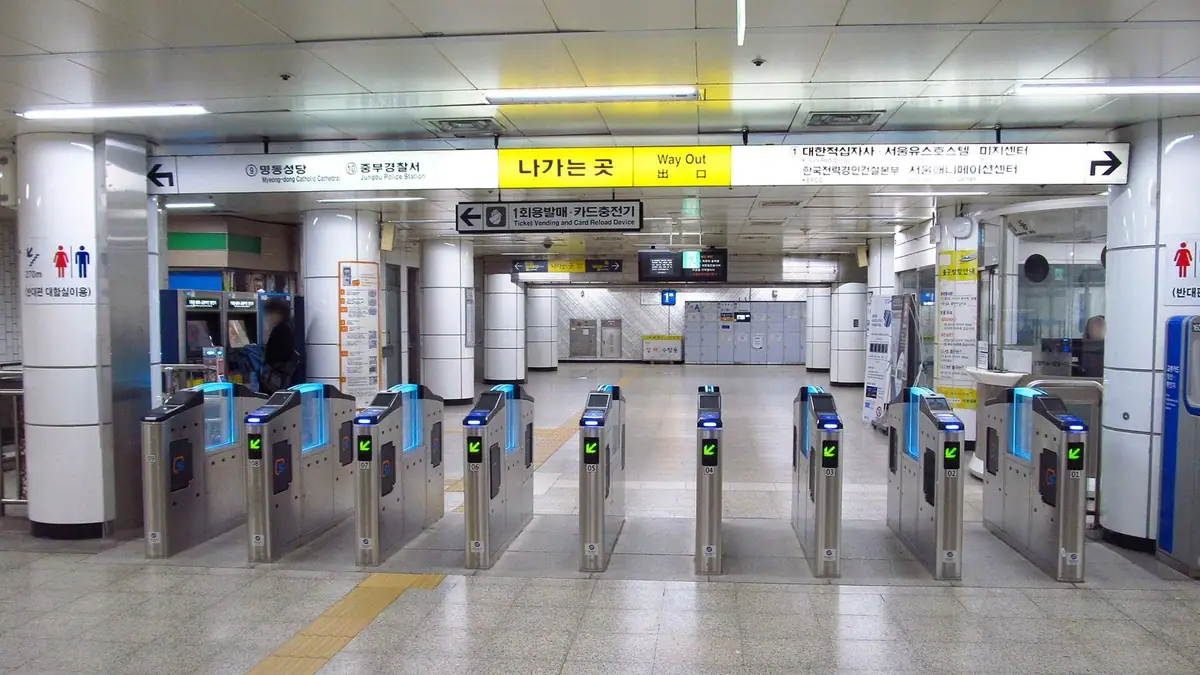
Myeongdong Station ticket gates, Seoul Metro Line 4 · Photo: LERK (CC BY-SA 4.0), via Wikimedia Commons
Climate Card vs T‑money
If you ride the subway or bus 3 or more times a day, Seoul's Climate Card short-term pass usually beats T-money: 1 day is ₩5,000 (~$3.45) and 3 days ₩10,000 (~$6.90), plus ₩3,000 (~$2) once for the plastic card. T-money is pay-per-ride (subway from ₩1,550, ~$1.07) and is the card for arrival day, because you can't board the AREX at Incheon Airport with a Climate Card. The Climate Card doesn't cover airport buses, red express buses or the Shinbundang Line.
- Passes
- 1 day ₩5,000 · 2 days ₩8,000 · 3 days ₩10,000 · 5 days ₩15,000 · 7 days ₩20,000
- Card
- Plastic card ₩3,000, bought once, then charged with a pass
- Covers
- Seoul subway and Seoul city buses. Not airport buses, red express buses or the Shinbundang Line
- T-money
- Pay per ride: subway from ₩1,550, blue/green city bus ₩1,500 (card fares)
Part of: Korea travel apps that work without a Korean phone number · Incheon Airport to Seoul
Seoul's short-term Climate Card gives unlimited subway and city bus rides for 1 to 7 days, from ₩5,000. What it covers, where to buy it, the airport catch, and when a pay-as-you-go T-money card is the better deal.
Which one should you get?
- RIDESCount your rides per day
With T-money, a subway ride starts at ₩1,550 (more on long trips) and a blue or green city bus is ₩1,500. The 3-day pass costs ₩10,000, about the price of 7 base-fare subway rides (7 × ₩1,550 = ₩10,850). If you ride 3 or more times a day, the pass usually wins; if you walk a lot, T-money is cheaper.
- AIRPORTThe airport catch: you can't start a ride at Incheon Airport
Seoul says the Climate Card covers AREX rides that end at Incheon Airport Terminal 1 or 2, but you can't board at those airport stations with it. On arrival day, pay with T-money (or a ticket); start the Climate Card once you're in Seoul. It covers the trip back to the airport on the AREX all-stop train.
- DAYSPasses run by calendar day, not 24 hours
A pass starts on the day you charge it, from the first train (4 AM) until the last train of its final day. You can't charge it in advance. Example from the city: a 1-day pass charged on July 1 works until the last train on July 1.
- COVEREDSeoul subway, Gimpo Goldline and Seoul buses
Seoul subway lines plus the Gimpo Goldline, within Seoul, and Seoul-licensed city, village (maeul) and night buses.
- NOT INWhat the Climate Card doesn't cover
The Shinbundang Line, GTX, subways outside Seoul, red express (광역) buses, airport buses and buses licensed outside Seoul. Short-term passes also don't include Ttareungi bikes or the Hangang Bus. If you get off at a station outside the coverage area, the full fare is charged (the city's example: board at Jongno 3-ga, get off at Indeogwon).
How to buy and charge the Climate Card
- WHEREStation machines on Lines 1–8, or convenience stores near stations
The plastic card is sold at the new-type transport card machines in Line 1–8 stations and at convenience stores near stations (also near Line 9, Ui-Sinseol and Sillim line stations). Seoul's Climate Card FAQ also lists the station service desks. Ask for the card by its Korean name.
기후동행카드 단기권Google Maps - PAYCash works; bring some
Seoul says the plastic card can be paid in cash or with a credit or debit card (not corporate cards). The city page doesn't say whether foreign cards work at every machine, so carry some cash (our tip).
- CHARGEPick 1, 2, 3, 5 or 7 days
Charge it at the unmanned charging machines in stations on Lines 1–8, Line 9, Ui-Sinseol, Sillim and Gimpo Goldline, on the day you want the pass to start. Short-term passes don't need card registration to ride; registration only matters for refunds.
- PHONEMobile version: Android only
The mobile Climate Card is issued in the Mobile Tmoney or Samsung Wallet app on Android 12 or later. On an iPhone, use the plastic card.
- REFUNDRefunds only while the pass is valid
You get back the charge minus the rides you used and a ₩500 fee, and only during the pass period. Register a plastic card on the Tmoney Card & Pay website first; unregistered cards can't be refunded. Visitors without a Korean bank account can get a cash refund at Tmoney's head office.
How T-money works
- BUYConvenience stores and station machines
T-money cards are sold at convenience stores (CU, GS25, 7-Eleven, Emart24) and at subway station machines. The card is sold empty; the price of the card itself depends on the design.
티머니 카드 - TOP UPTop up with cash
Hand the card and cash to a convenience store cashier, or use the top-up machine in any station (switch it to English).
- TAPTap in and tap out, also on buses
Tap when you get on and again when you get off the bus. Transfers between subway and bus are discounted within 30 minutes of getting off (60 minutes from 9 PM to 7 AM), for up to 5 boardings in a row.
- EARLY20% off before 6:30 AM
Seoul takes 20% off the base fare for the first ride of the day if you board before 6:30 AM with a transport card.
Affiliate link: if you book, Seoulful earns a small commission at no extra cost to you.
Say it in Korean (show this screen)
- SAYA Climate Card short-term pass, please.
gi-hu-dong-haeng-ka-deu dan-gi-gwon ju-se-yo
기후동행카드 단기권 주세요 - SAYA T-money card, please.
ti-meo-ni ka-deu ju-se-yo
티머니 카드 주세요 - SAYPlease top up ₩10,000.
man won chung-jeon-hae ju-se-yo
만 원 충전해 주세요
Local tips
- Our tip: on arrival day, buy a T-money card at the airport for the ride into Seoul, then start a Climate Card the next morning if you'll ride a lot.
- Our tip: a pass you charge in the evening still ends at the last train that day, so start it in the morning.
- Seoul ended the monthly (30-day) Climate Card in October 2026; the 1, 2, 3, 5 and 7-day passes for visitors are still sold. Fares and rules can change, so check the city's Climate Card page before you buy.
- Our tip: keep the card. You can charge a new pass on it on your next trip.
Guides in this topic
 Getting around
Seoul bus says "jan-aek-i bu-jok-ham-ni-da"? Your T‑money is empty
Updated Oct 28 Practical
Cash or card in Seoul? Where cash still matters
Updated Oct 30 Getting around
Foreign cards on Seoul buses: the 2027 plan
Updated Nov 9 Getting around
Seoul subway guide for first-timers
Updated Nov 2 Getting around
Incheon Airport to Seoul
Updated Nov 11 Getting around
Cheonggye A01: Seoul's self-driving bus now runs at night
Updated Oct 22 Getting around
Seoul's river bus in winter
Until Feb 28FAQ
How much is the Climate Card for tourists?
1 day ₩5,000, 2 days ₩8,000, 3 days ₩10,000, 5 days ₩15,000, 7 days ₩20,000, plus ₩3,000 for the plastic card.
Can I use the Climate Card from Incheon Airport?
Not to start a ride. You can ride the AREX all-stop train to Incheon Airport and get off there, but you can't board at the airport stations with the Climate Card. Use T-money or a ticket on arrival day.
Does the Climate Card work on airport buses?
No. Airport buses, red express buses, the Shinbundang Line and GTX aren't covered.
Is T-money or the Climate Card cheaper in Seoul?
It depends on your rides. A 3-day pass (₩10,000) costs about the same as 7 base-fare subway rides at ₩1,550, so it pays off if you ride 3 or more times a day.
Does the Climate Card still exist in 2026?
The monthly 30-day card ended in October 2026, but Seoul kept the short-term passes for visitors.
Sources: Seoul Metropolitan Government: Climate Card guide (coverage, short-term pass prices, validity, refunds) · Seoul Metropolitan Government: Seoul subway and bus fares, transfer and early-morning discount rules · Etoday: Climate Card short-term passes, 1–7 days, ₩5,000–20,000 (June 2024) · 10 Magazine: 30-day Climate Card ending; short-term passes continue (2026) · Etoday: Seoul-area subway base fare ₩1,550 from June 28, 2025 · Hankyung: subway base fare rises from ₩1,400 to ₩1,550 (June 2025) · Sateconomy: Seoul city bus fare ₩1,500 from Aug 12, 2023 · The Soul of Seoul: where to buy a T-money card · Trip.com: T-money card guide 2026 · Seoul Metropolitan Government: Climate Card FAQ (2026) · Seoul transport site: Climate Card short-term pass · Seoul Media Hub: Climate Card tourist pass (2024) · The Fact (2024) · 10 Magazine (2026)